Thursday, July 23, 2015

Origins and Progress


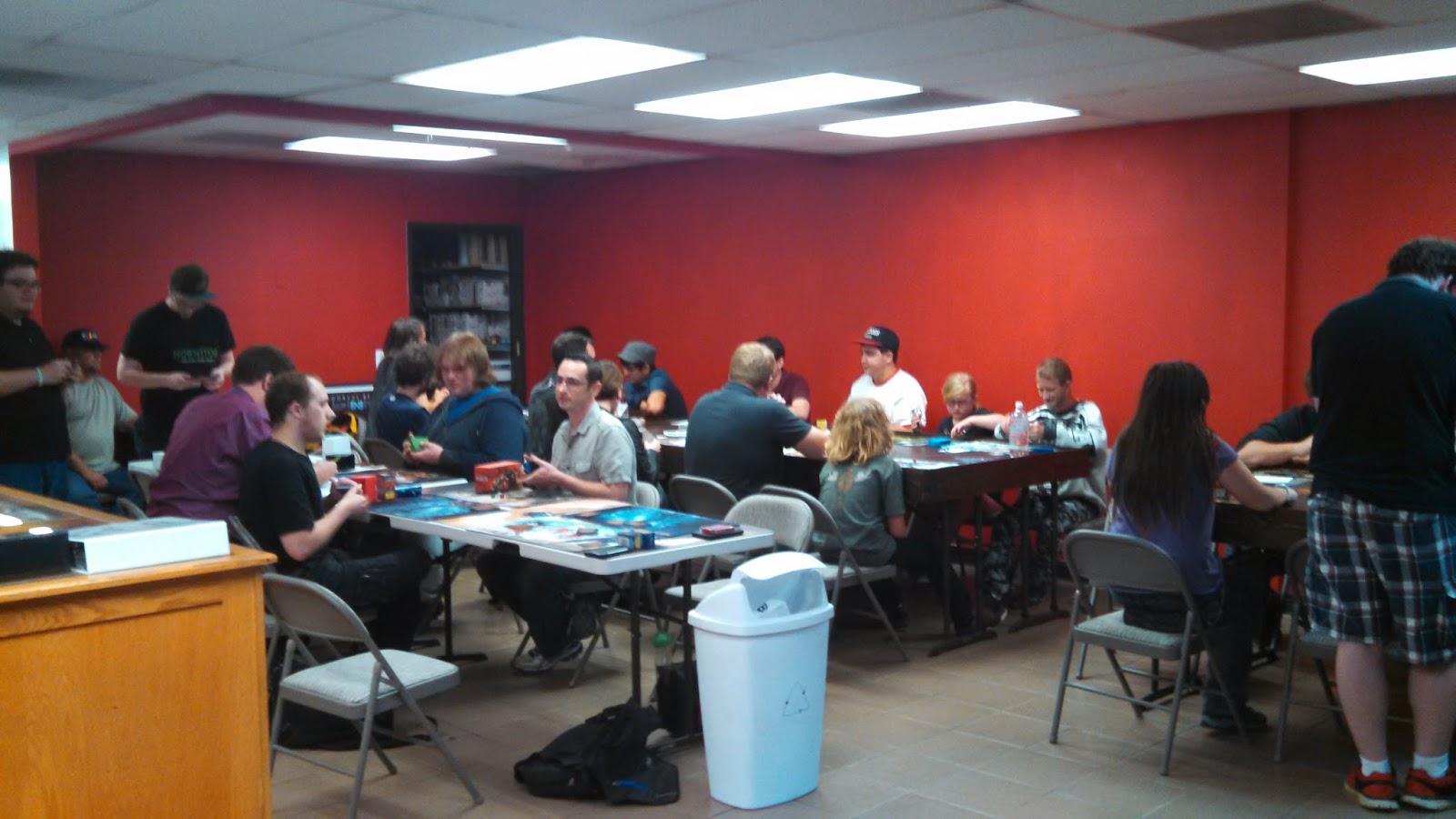
Origins prerelease was this weekend and I thought I should go into a little biography of myself, as an origin story so to speak. What brought this on? I'm the sole owner of Adventurer's Quarter again, as Justin has moved onto greener pastures with his Cardboard Clothing Kickstarter.

For most of this year I've worked a second job in addition to AQ and will probably continue to do so until I can get the store to a place where I'm comfortable with its' success. I don't tell people I'm working a second job out of pity, just more as a "What I'm doing with my time" concession. Growing up in Maryland & North Carolina, my parents always worked 2-3 jobs a piece. So it feels normal to do so because I was raised to work hard to get what I want. It's tiring, naturally, but work is necessary to accomplish great things.

I spent years playing video games with friends online because there weren't game stores to go to where I grew up. When I moved to Washington for college the first thing I found was people looking to play RPGs around campus. I found in Seattle more game stores that I could shake a stick at and discovered board and card games. In this way I learned to be liberal with my gaming attachments. Whereas some people only play euro-games, or Magic, or D&D; I learned how to play them all and enjoy them for what they were: Social engagements.


It is through this desire to meet people in a tabletop setting that I started AQ, I think, and this openness to try all types of games that allows me to succeed where other stores might fail. I don't focus on one thing, instead I carry what the community wants me to carry because they are both my customers and the people I engage with on a daily basis. Seeing old faces come out of the woodworks every Magic prerelease makes me smile knowing that they only play during these types of events and when they do, they come to my store because it's a friendly environment where you can win some fun prizes and have a good time.

I'm working to progress the store towards a stable place where there aren't bills piling up because of past mistakes and soon I'll be able to do that. The idea next month is to go the extra mile and launch a Kickstarter myself to transition the store into a true destination location, where there's beer and food and a reason to hang out beyond just gaming. If I don't launch a Kickstarter it's because I've found other avenues to fund the beer license and we'll simply move forward and get shit done. I want the store to be a place to chill and meet new people more than I want it to be a store you go to expecting to play a certain type of game. We'll continue to have the same growing library of games and carry the next best thing from Fantasy Flight, Magic, and more, but ultimately if there's nothing coming out that strikes your particular tabletop desire this month we'll still be a fun place to visit and grab a pint.


Making Adventurer's Quarter truly a place where adventurer's gather to socialize has been the goal of all my encounters with board gaming. Whereas I might appear rather stoic and calculating in my conversations at the shoppe, my passion within the shoppe is truly to meet new people and hear about what they love to play. Most of our Odyssey beernights once a month result in the group hanging out and talking more than playing games because that connection through gaming is more important than the games themselves. As the future of AQ approaches and the its' survival depends entirely on my decision making and your willingness to participate in it, I hope you'll join me on this adventure soon.

Tuesday, June 2, 2015

Blood Red: Or why Branding matters.

The store is covered in blood. Well, red paint. Justin, my partner, started a board game clothing company and produced some new AQ shirts that have a red line with our key symbols of meeples, dice and board game paraphernalia. From there we're changing the window to be a red line with our name on it instead of the busy green bits and posters that is now. We'll be covering the walls with board game art. Why are we doing all this?


The ambiance of the store is that of a playspace for most of our regulars. People come to play games that they enjoy and find others that do as well. The shoppe portion of the store is being revitalized so that we carry a diverse selection, ideally one of every type of game out there. Statistically speaking, the more games we have in stock, the better odds that someone coming off the street or playing games can find the one they're looking for at the time. Going with a more modern look should attract more adult gamers, which are 98% of our clientele. In this way we hope to get our beer license out of the way this summer sometime so that they do adult activities like drinking with their favorite hobby as well.

I think the appeal of AQ has long since been that we provide a clean, well-lit, and non-gamer-smelling shoppe compared to a lot of stores people are used to. We want to be a retail store first, a community second, and a resource to players of all ages third. People are always remarking how much they like the look or feel of the store, so our intentions in changing its' color and interior design is only to exemplify that fact going forward. If we can make the store ultimately appealing to every single person who enters because we're different from what they expect then it has the potential to provide long term retention and dividends. Our Five Stars rewards program concept is paramount to that, as it namely rewards regulars with persistent discounts and deals and helps brand new people remember what we're about with reminders that we are running events and here to support their gaming choices.

The warm glow of red in the store should also psychologically encourage more eating when we have better food options and make the store more homey during the gray winter months as well. Stores like Haunted Game Cafe and shoppes in Oregon we've researched have similar color schemes as well as a few bars around the Denver area. Red jumps out at you, says "Hey, we're here. We know exactly what we're about and we want to better serve you because of it." It's not a passive color and I think that reflects our personality as AQ strives to succeed into our second year of being in business.


Tuesday, February 17, 2015

Random Chance: When is a game just luck?

Randomness is a big part of gaming, but it is often overlooked as how much it can influence overall gameplay. Whether from a dice roll or a deck of cards, there's always a level of randomness to be expected from a game and how it affects the game can be as seamless as transitioning between turns or as jarring as needing to yell at the dice for not going your way.


Last year's Spiel de Jahrs award went to Camel Up, a racing game where you bet on camels as they make their way around a track. Every turn you pop out a dice from a tower to see how fast one particular camel moves or you bet on a color. Ultimately the game concept is very unique looking and the stacking of camels that are on the same space is an innovative way to demonstrate a tie, as well as how you break the ties by keeping camels above others in the same position as they race along. For my money, it feels like Camel Up is a literal "bet on a race" game, simply because you bet on them and either win or don't. There doesn't feel like much strategy to be had because it's all down to dice as to what camels end up winning. It's more an odds game and statistically you might be able to predict a winner eventually, but ultimately your decisions are more about what's happening beside the game than what's happening in the game. It's a flawed game, but won the game of the year award for design and play. Its' randomness is critical to the game working, but ultimately the game plays itself and you just bet and hope you win.


There's a certain degree of player involvement that is necessary to keep a game interesting. King of Tokyo manages to be a dice rolling game with decisions to be made on "what you keep" by rolling the dice 3 times and deciding what your turn will be about. You might not always get the rolls you need, but you'll get 80% of what you want, making for a feeling of importance as to what you're doing in the game versus what the dice are just randomly doing to you. If the game is simply random, then it loses replay-ability, as you know next time you play it'll be down to luck whether you win or not. So long as the game has inherent strategy that governs when things are random and when you get to make decisions, it'll benefit the longevity of whether or not you keep playing.


Deck builders tend to have a good handle on when to deal with randomness by having shuffling increase the odds of randomness, while the cards you add to the deck are up to you. Magic: The Gathering does this very well, given that you craft your entire deck and when cards come up is the only luck available to you. Although the game gives you options for statistical improvement with scry effects (looking ahead at the top of your deck), fetch effects (thinning out your deck by fetching a card and reshuffling the remainder, thereby improving the odds of finding anything else) as well as the ability to play from your discard pile (graveyard) or your opponents deck. The elements of randomness are handled as an inherent probability that is within your power to control. This makes most games of Magic varied and about decision making. The choices you make to interact with your deck determines how random you want your game to be, which is why it remains a popular game that has infinity replay-ability.

Finally, when it comes to randomness, there is the King of Random to consider: RPGs. You roll a dice, add your associated skill to improve the odds of success, and get a result. When I play RPGs at low levels I have very few skills, so how I interact with the world is erring on the side of more decisions versus hoping randomness works in my favor once. If I constantly roll dice to make decisions I should have no possible ability to succeed at then eventually I will succeed and build my character's arc. For instance, as a low level Wizard I snuck onto a boat with low level spells and simply because I knew people were of similar level to me, I became invisible and went below deck to set a trap on their powder kegs. I have no inherent ability to do this trap, but because I rolled well my experience and decision making was rewarded. Even if I had failed, my decision would feel like my own so the randomness of the dice would feel like more of a character flaw than a game system flaw.

The point of randomness is definitely one of making the game feel tense, but it doesn't have to mean the game is pitted against you either. I try to play all games with an RPG mindset so that so long as I can make decisions that allow me to give the game personality from my own decisions I can enjoy it. It isn't down to just the pages of text and dice in the game because ultimately a game is something we share as a group in our imagination and if it's all numbers and chance, there's no imagination or influence we grow the game as a valuable experience for players.

Wednesday, January 14, 2015

AQ Against Humanity

Cards Against Humanity is the best selling game of the past decade, bar none. It's Apples to Apples meetings offensive phrasing. Unfortunately for us it's an Amazon exclusive, rather than through distribution, so we, like every game store around, must order it and mark it up. What is the phenomena of this game and why is it so popular?


Ultimately it is popular because it's the easiest game in the world to play. It requires zero imagination to play with anyone off the street. The answers the judge must choose are as verbose and graphic as possible so that no one has to read between the lines to discover your intentions at winning the round. In Apples to Apples it's a lot more vague and requires foresight into why you might have chosen a particular answer. Something similar to this game style comes across in Snake Oil, where you have 30 seconds to pitch your answer of non-sequiters to become the winner for the round. In CAH it's simply: What is funniest? The cards are what are funny, not your choice. You simply get to be funnier than any other card in the round, but it requires no effort on your part generally. Playing one person randomly into the pot has just as much chance of winning as you debating your answers.

The reason CAH uses Amazon is pretty clear. Amazon is a big-box store of the internet. It only cares about what sells and tries to sell everything at rock-bottom prices because its volume makes up for the margins. People voluntarily choose not to shop at Wal-Mart because they don't want to support bad hiring habits or price gouging that ruins local businesses, but because Amazon is online it's easier to just hit the button and forget about your choice. To buy something cheap online requires no imagination or moral commitment, much like CAH.

Ultimately the reason for this blog is discovering less about why CAH is popular and more who chooses to play the game. I can honestly say 95% of the people asking for CAH in store off the street come in specifically looking for it hoping it's here. When I pitch Apples to Apples, Snake Oil or even Cash n Guns they want nothing to do with my knowledge. They don't respect that there might be better games out there: they want the one offensive and easy game they came looking for today. I don't disagree that the customer deserves to get what they're looking for, and that many gamers play CAH as well, but generally speaking the people who play or want CAH are not gamers. They want nothing to do with the gaming community, they simply want to be the cool-kid with the offensive game about cocks to be a laugh riot with their family or friends. Nothing wrong with that.

As a game store with a community though, CAH brings with it a toxic problem that it attracts gamers who are not interested in finding new gamer friends. They aren't seeking to expand into the hobby of gaming at large. They want a game that has all the answers, no hard rules, no real challenge; just cards full of dirty words that are interesting to their group. To support these gamers in their hobby of playing CAH I have to support a big-box store like Amazon to get them the games they seek. 90% of my regulars tell me they'd rather spend a little more to keep me open; that they'd rather me order in CAH and mark it up than they buy it from a place like Amazon. Ultimately I'm still ordering it from Amazon, keeping them in business, and all it's doing for me is making a new distributor that is also basically my biggest competition for pricing on every other game I sell.


Cards Against Humanity is a big-box, bottom of the barrel, option for gaming. There are great entry-level games for all ages out there that are just as accessible that I'd rather a person off the street try honestly. Takenoko does resource management and modular board building really well, just as 7 Wonders introduces people to civilization-style card management in a quick-to-learn setting. Even something like Munchkin does wonders at teaching you how to add gear to a character to screw over your friends with a hand of cards. There are games out there built for new gamers but most CAH buyers want only to play CAH, not to grow the hobby or meet new gamers. They'd have just as much fun with a different game if the willingness to try to use their imagination existed within the world of gaming, but instead it is trapped in a vacuum of offensive jokes that require no effort.

I suppose the point of board gaming is three-fold: 1 To learn how to play a system with your friends, 2. To experience the world and setting a game designer has made, and 3. To enjoy conquering the rules system to win the game for yourself or the group in a competitive environment. If we are to be gamers, yes we can play CAH with a drink and friends, but we can also try new things and game within the world of table-top gaming in all aspects to better understand what it means to be a gamer.


In the spirit of CAH, after criticizing it for several paragraphs, I'd like to note that AQ will be carrying the game more frequently come February, so swing by and grab a copy if you're looking to add it to your collection. While you're in, might I suggest playing a game of Splendor with us and seeing what beautiful game design looks like as well.

Good gaming,

Friday, December 19, 2014

Naming the Party

What's in a name? I hear people mispronounce the store's name all the time as Adventure Quarters/Adventurers Quarters as if my singular store was a plural entity. It's not a huge deal, but perhaps the name leaves some confusion to be had. What the hell is an Adventurer's Quarter anyway?

In reality (well, fiction, but it's where we got the idea): it's a district in the fictional town of Waterdeep (better known in D&D, and nowadays in Lords of Waterdeep the board game). It's where the Adventurers go to get their magic items, meet other adventurers and generally feel less like members of the city and more like members of a group that knows what adventure feels like. Why name a store after something like that? Probably because that's what I would always hope a game store could be for people: to meet other like minded adventurers in the world of gaming. It's cheesy, but nerds always need other nerds to play games with and having a place they can meet up is essential. At its' core a game store is that district for modern day gamers.

To play a video game nowadays you just load up the game and bam-you're on an adventure on your own. It's self-contained. To get into a table-top game's adventure you need a party. Be it in D&D, a board game or a Magic tournament. At the end of the day you need to gather your fellow adventurers and prepare to quest towards a singular goal. Be it stopping the pandemic, saving the princess/dragon, or taking out that X-wing before it kills your pilot.

So while some stores in Denver and around the world go for the more generic: Blah Games, Science-Jargon Gaming, etc. I like to think that using a more evocative style of game store name gets to the heart of what a store can be about. You might not see rolling some dice or playing Ticket to Ride with your family over the holidays as an adventure, but it is just that: a quest for fun.

Hopefully 2015 is filled with plenty of Adventure for you and your party.

Thursday, December 4, 2014

Community Involvement and the Magic of Gaming

Learning new games can be difficult, since board games take learning the rules outright before you play and RPGs take commitment to a setting and a system to understand. Finding the easiest games to learn is essential in my line of work and nowadays Magic: The Gathering is strangely the easiest thing out there. There's free video games to learn the basics, intro decks to understand how to play in person, and even though there's years of cards to learn; typically the Standard set of Magic makes rules interactions the easiest. I know I've spoken a lot about how Magic integrates with the store, but this may be the post that explains why I keep doing it. 

Magic is a gateway game. The second someone knows how to play Magic, they're going to make a friend across the table who they learn to play games with immediately. As they make more friends and get better there's going to be more and more complexity to their gaming experience. In my mind, that means that eventually they'll have 4-5 friends that want to play something that lasts longer than the typical 40 minute Magic game. So naturally this means that the more people feel comfortable with Magic, the more likely they are to play board games and break into a world that is built for cooperative/competitive play with many moving parts. It is because of this progression of actions that I'm always on the lookout for new players so that I can eventually get them into the world of table-top gaming on a larger scale.


It is for this reason that I'm going to attend a PTQ run by another local game store called Black Gold. A friend and I have been learning to build decks competitively and want to participate in their smaller all-day-tournaments so that we can 1. Win some cool prizes, 2. Meet some competitive players that we don't normally play, and 3. Show that local game stores can compete casually for the benefit of growing the hobby as a whole. Initially I was concerned about the perceived impact my playing in a tournament would have; namely "Why is a competing store playing in an event, taking packs, winning with their 'inside knowledge'?" but I think there's value to be had in making a showing with an AQ playmat and meeting people. By participating in a big tournament I can learn how to be a better player, which will ultimately help my store grow. I can also show support for the growing tournament scene, support another local store by showing up, and grow the hobby into a greater friendlier experience for all involved. 


Camaraderie with local game stores is hard to come by. Most players think we're all competing with each other to put another out of business and it is in their benefit to get the most out of one store over another price-wise until one disappears and another rises in its' place. Since I've been here in Arvada I've tried to be a friendly store always looking out for where players can get what I don't have. There's always a game you don't carry or don't have a community for, so I direct players all the time to stores nearby that can better serve their needs. Only through working together do smaller stores survive, so showing support for another local store seems like a way to find the players that can't get all the way South to the guys running the tournament and capture players that might live closer to my shoppe and not have heard of me yet. 


The experience of building decks with friends is an exercise in statistics and social interaction. There's a whole world of experience in tournament settings that influences overall prices of cards and value of cards in particular over another. Every time I build a deck with a friend of mine we learn a little something new about how to counter each other's concepts, which we've arguably only learned by playing and discussing strategies with another over the table. We've played RPGs together and find synergy within our class-concepts all the time to build party cohesion, so the experience in Magic is very similar. Through one table-top game we progress our expertise in another as understanding systems is essential to any games we play. 


I hope to learn something valuable from playing in a tournament on a larger scale than ones I run all the time and at the very least can thank local players for being as good as they are for informing the meta and growth of the hobby towards something competitive and powerful for building communities. We'll see if I lose like a fool or win by some stroke of luck, but hopefully I can find new players interested in participating in the larger community of table-top gaming and better represent my store as something bigger than itself. As something concerned with the success of all local stores and the development of something as simple as a hobby into something as important as a community. 


Tuesday, November 18, 2014

In-Store Trade and Inventory Success

Khans of Tarkir, the most recent Magic: The Gathering set, is a problem for my small shoppe. If you buy a full box of packs and open them all you tend to get your money back in spades. Judging by last week's draft, had we opened it instead of drafting: 6 Fetch Lands (60-75$), 1 foil Fetc ($45), 1 Sorin Planeswalker ($20) comprised part of the box, which is $120 minimum, not counting all the other rares that may have been a buck or more. Arguably, that was a great box of cards, but typically just coming in and buying 3 packs, there's pretty good odds of getting $14 and getting 2 more packs, thus beginning the cycle of trades over again as we give out half credit for cards. 

This is just how Magic works though, it isn't inherently bad for my store, as it turns what was once a 20% margin off the pack into a 50% margin off the cards, so perhaps closer to 35% after the wash of transactions occur. It's an interesting issue though, as all MTG stores survive off singles as far as I can tell, but to maintain a level of singles necessary to stay open you need a shitload of packs in the store. 

Strangely AQ survives off a little bit of everything, so to order in a bunch of packs/boxes of Magic cards requires me to not get in preorders for folks that pop in once a month. It requires giving up money in the future for money every day. No matter the weather, or slowness of events we run, Magic will continuously sell every single day without fail. So we walk the line, carry a little bit, but not too much. The second we're off the ground running, it'll be obvious to regulars; as we'll have every Standard block of packs in stock, as well as a booster box on hand for those who want it, not to mention a full wall of sleeves and deck boxes to compliment them. 

I've recently been watching Derium's CCG channel, which is both entertaining and elucidating in its' store's daily operations. It's fun to see the little things a store like my own does during the day and how much volume they must move. They've got a constant web presence from their #Cardshoplife videos and more, but it's especially necessary because of their reliance on eBay and TCGPlayer to have an impressive web presence. AQ does well on TCGPlayer, but ultimately until we have more packs to just open and sell, it'll never quite be at its peak. A store like Derium's appears to open a few cases (6 Booster Boxes per case, 36 packs per box) every week, which is ideally where I'd like to be. It just takes that little extra a month to maintain that level of stock. I think AQ will get there, but in the meantime, learning from the best seems like the way to go at the moment. 

So what does all this mean? When times are slow we latch onto Magic as lifeblood to survive because it's volatile yet consistent in its' results. To maintain board games in the shoppe we need board gamers to buy more, or at least preorder more; but that isn't easy either. Board gaming companies are notorious for changing street dates, delivering only a few copies per store, and simply being unreliable. Who would want to preorder the next big thing in board games if it wasn't guaranteed to be at a certain date? Magic and D&D have hard street dates that typically never breaks, so when you preorder a box you know the exact date you'll get it and preordering that is doable because of confidence. In the meantime, I'll continue to take in cards for games, for packs and for more of the same because it's a way to get over the bumps in the road that the industry has put up.